

FIPP Global Media DEI Tracker – June 2024
Welcome to the June 2024 edition of the FIPP Global Media DEI Tracker, supported by the Google News Initiative (GNI)!
From membership models and employment initiatives to extensive training and advocacy, today’s media needs to take bigger steps to create a truly diverse and inclusive culture. FIPP invites media owners around the world to share what they are doing to support DEI. It is collectively and by sharing ideas that we can make the biggest impact, and move beyond quotas and value statements to make our industry truly accessible.
If you’re doing something to shift the landscape, we want to know. You can get in touch with FIPP’s editor Sylkia J. Cartagena.
Quote of the month
“If you haven’t got programmes to meet people in their communities, putting them in a position of strength rather than coming in like a middle-class missionary, you’re not doing it right.”
Neil Griffiths, co-founder of charity Arts Emergency
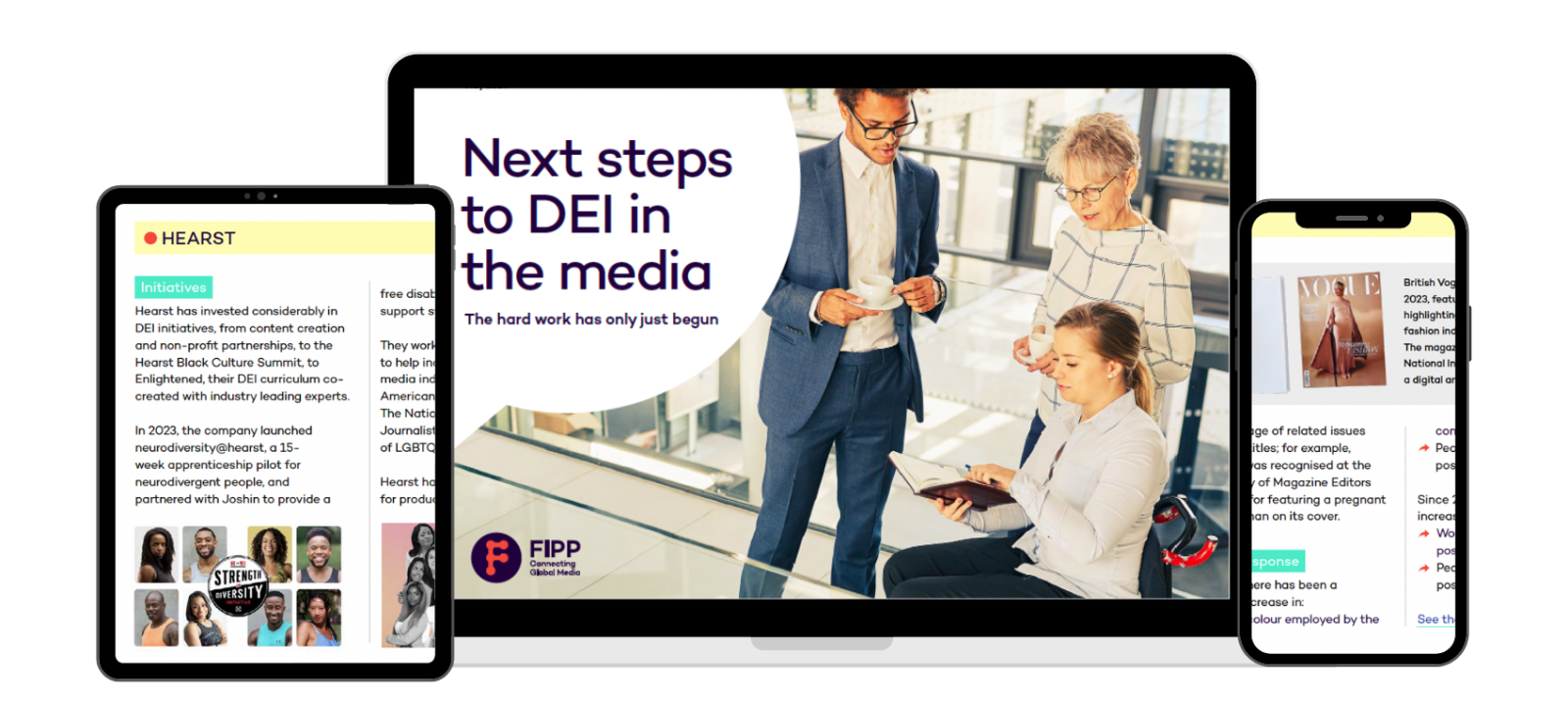
New FIPP members report: Next steps to DEI in media
Download now
General
FT Strategies has produced an in-depth report looking at news consumption amongst the next generation. The study, which came from interviews with young consumers from Nigeria, India and the USA, looked at modes of consumption, perceptions of credibility, trust and transparency, and how to build affinity with the audiences of 2030.
At the recent PPA Festival, a panel hosted by Lisa Smosarski, Editorial Director at The Stylist Group, tackled AI’s gender bias problem, discussing how publishers should be working with AI to prevent (implicit) biases. Eleanor Krivicic, VP and Assistant General Counsel, International at Shutterstock said, “it’s indisputable that these models are generally created by the tech industry, typically in the Western world and by white men. So, that’s what’s contributing to these biases.”
Content Designer Dawn Kofie shared a LinkedIn post suggesting how potential employees can spot ‘diversity dishonesty’ (when employers give the impression that they are an equitable and inclusive employer when they are not), from before the application process to job interviews. There’s valuable info for employers here too: pitfalls to avoid include recruiting people already known, instead of venturing outside networks, only making pay scales available to certain individuals and assuming that being ‘nice’ is the same as being ‘inclusive’.
Francesca Donner, formerly of The New York Times and The Wall Street Journal, has launched The Persistent, a journalism platform for amplifying women’s voices and perspectives and pushing back on “sexist tropes and gendered defaults”. The platform offers essays, shorter pieces and Q&As with high-profile women.
Creating inclusive environments for the neurodivergent begins at interview, an article in Fast Company reports. Interestingly, the article states, neurodiverse individuals may not understand the ‘hidden motives’ behind seemingly simple questions such as “describe your past work experience” or “do you have any questions?” The article includes suggestions for interview techniques that accommodate the neurodiverse community in a more meaningful way.
Project 23 is partnering with Humble Associates for an online event, ‘From Fear to Action: Empowering Leaders in DEI’ on June 18th, 2024. The webinar, featuring four experts in diversity, equity and inclusion, aims to empower leaders to realise that DEI is a sound leadership strategy, particularly when it comes to attracting the best talent and driving innovation.
United Kingdom and Europe
A report published by the Creative Industries Policy and Evidence Centre has found that working-class people are underrepresented in the cultural industries, making up only 8.4% of the creative workforce. The same repot discovered that 90% of workers are white, and only 20% are disabled.
The LGBTQ+ Journalism Network – the aims of which are to connect the LGBTQ+ community, highlight LGBTQ+ voices, and model an industry that recognises LGBTQ+ voices and stories – is welcoming new members. Founder Sophie Perry says, “LGBTQ+ stories are not separate from news, they are news.”
The latest issue from Substack newsletter Reframing Disability highlights the need for more training and resources when it comes to good disability reporting. It includes an interview with Shreya Raman, an independent data journalist who reports on gender, health and public policy, who states that, “We need to look beyond the binaries of a disabled person and an able-bodied person and report on the nuances in the lived experiences of disabled people and the role of power structures like patriarchy, colonialism and caste system in exacerbating the challenges faced by disabled people.”
“Why so few women winners at the Regional Press Awards?” asked Behind Local News, a website dedicated to regional news in the UK. Although hundreds of journalists entered the awards, only 2 of 11 trophies went to women, sparking discussion amongst the attendees. Gill Sutherland, content editor at the Stratford-upon-Avon Herald, said, “In an industry where the workforce is split more or less evenly between the sexes, women picking up just two awards is a shameful statistic that reeks of yesteryear sexism. It’s Ron Burgundy territory.”
Inclusive Journalism Wales has published its Mapping Public Interest Journalism in Wales report, with a focus in particular on diversity and inclusion in the sector. Headlines included:
- Compared to the general population, there is an imbalance of gender, age and socioeconomic backgrounds (the majority of journalists being 45 – 54-year-old men from middle-class households)
- Newsrooms and organisations are not inclusive of disabled people
- Most content does not represent the full range of people and communities that make up Wales
- Short-term, project-based funding and tokenistic gestures are not sustainable
- There is a tension between journalistic aspirations and the type of content that gets engagement.
Last month, a panel at IPI’s 2024 World Congress and Media Innovation Festival, which included women industry leaders from Kenya, Nepal, Brazil, Serbia and El Salvador, discussed how feminist values can benefit the media landscape. Catherine Gicheru, Director of the Africa Women Journalism Project, said that gender should be the default perspective guiding storytelling: “If you’re going to write about politics, how is that impacting 51% of society? If you’re going to write about climate, where are we in the story?”
North America
Neilsen has released a report on the media preferences of AANHPI (Asian American, Native Hawaiian and Pacific Islander) audiences, which includes approximately 22 million people across 20+ countries. Among the findings: 64% of AAHNPI people said they would stop buying from brands that devalue their community.
The MMCA (Multicultural Media & Correspondents Association) hosted its Sheroes in Media Awards in March to celebrate women “who exemplify diverse media excellence”. Winners included Janet Dewart Bell (Board Chair, Women’s Media Center), Alicia Bell (Director, Racial Equity in Journalism Fund, Borealis Philanthropy) Nicole Dungca (President, Asian American Journalists Association) and Katherine Reynolds Lewis (Founder, Institute for Independent Journalists).
To celebrate AAPI Heritage Month, MassLive has been publishing profiles of media people from within this community, including Abby Chin, who worked at ESPN before becoming a reporter for the NBA. She has advice for other minoritised women in the media: “Working in a male-dominated industry can be at times intimidating, frustrating and discouraging. Recognise that your perspective and experiences bring valuable diversity to the field. Embrace your uniqueness and use it to your advantage in telling stories and connecting with audiences.”
Science has offered two paid internships to its Diverse Voices in Science Journalism program. The program aims to train students for a career in science journalism, which has a particularly poor record for accurately reflecting diverse communities. Both graduate students will work alongside the magazine’s writing and editing teams for 11 weeks.
Related content: Giving people a voice – an interview with Jacqui Barrett
After 15 years at the BBC, Jacqui Barrett understands the importance of producing content to “inform, educate and entertain”. Here, she talks about her award-winning business Wider Thinking, the importance of data and her drive to create EDI learning with a difference.
Australia and New Zealand
The Diversity Council of Australia has just appointed Sunita Gloster, a leading diversity and sustainability advocate, to its board. CEO Lisa Annese told B&T that, “There are no other sectors that influence the culture and the zeitgeist more than the media, so it’s especially important for the media sector to respond to changing societal and community expectations.”
Writing in the New Zealand Herald, Susana Suisuiki asks what the future holds for Māori and Pacific journalists amidst shrinking opportunities and potential reductions in funding to support diverse voices?

Asia
Omnicom Media Group, India has appointed diversity and inclusion leader Rita Verma to the role of Chief Talent Officer. In her previous roles she spearheaded Omniwomen, which improved access to leadership roles for women, and OPEN Pride, an initiative promoting LGBTQ+ inclusion in the media workplace.
Africa
A new initiative by UNESCO aims to promote disability equality in the African media by collaborating with media associations, broadcast execs, community media and regulators. After a series of discussions at the 3rd African Media Convention, it was announced that UNESCO would soon be releasing a new masterclass video series and manual to boost disability equality in the media, covering the following three areas:
- Inclusive editorial content and equitable media programming
- Making media content and operations accessible to persons with disabilities
- Adopting inclusive management practices.
Writing in The Conversation, Prinola Govenden (Senior Lecturer, Department of Communication and Media, University of Johannesburg) says that although progress has been made in diversifying the South African media, ‘race’ is still a powerful source of division when it comes to media management and content provision. She calls for a “critical assessment” of what has worked or not in the last 30 years since Nelson Mandela first highlighted threats to freedom of expression in South Africa.


